
Here comes the Sun
A story about seeds, loafs and infinite circles.

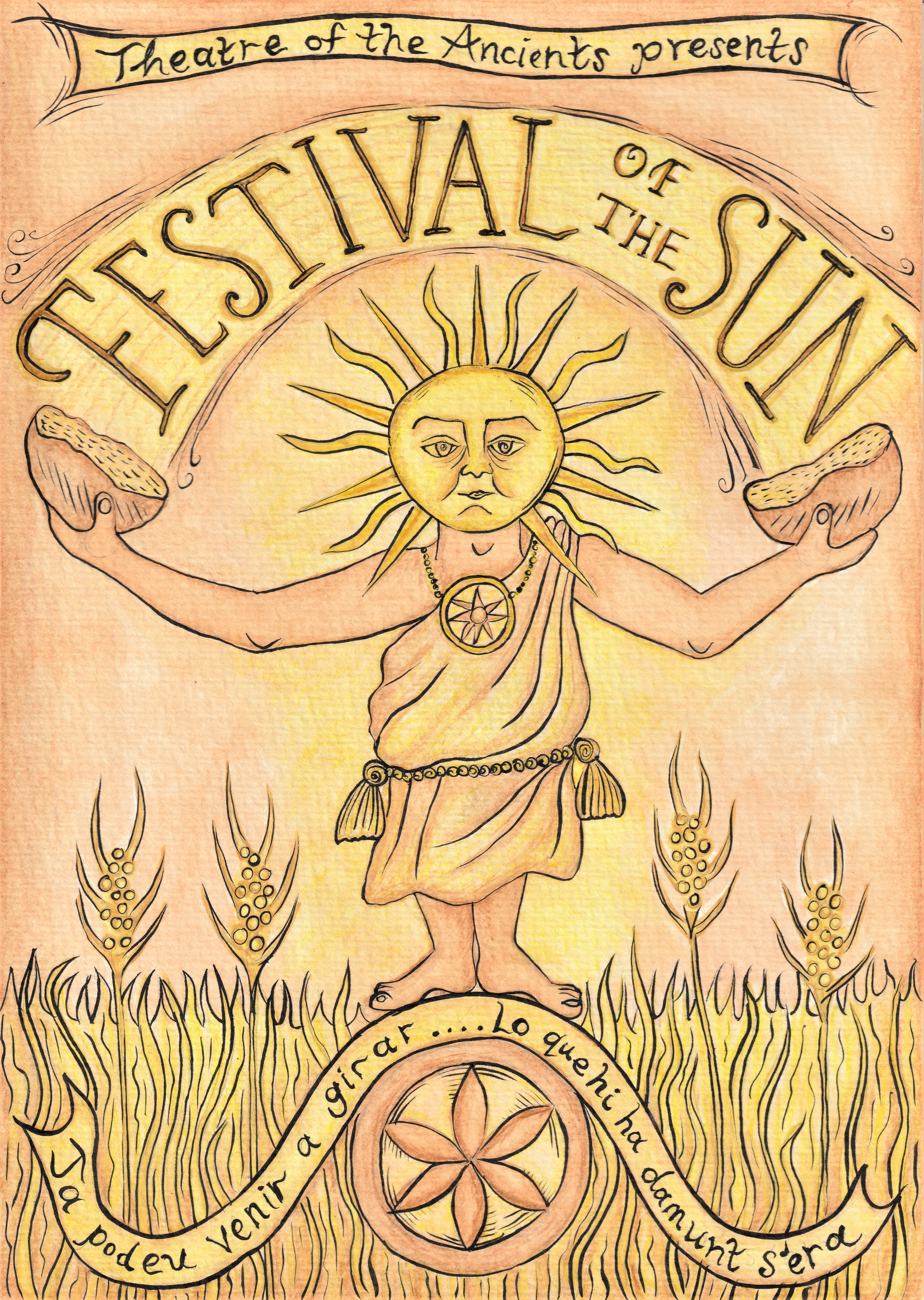
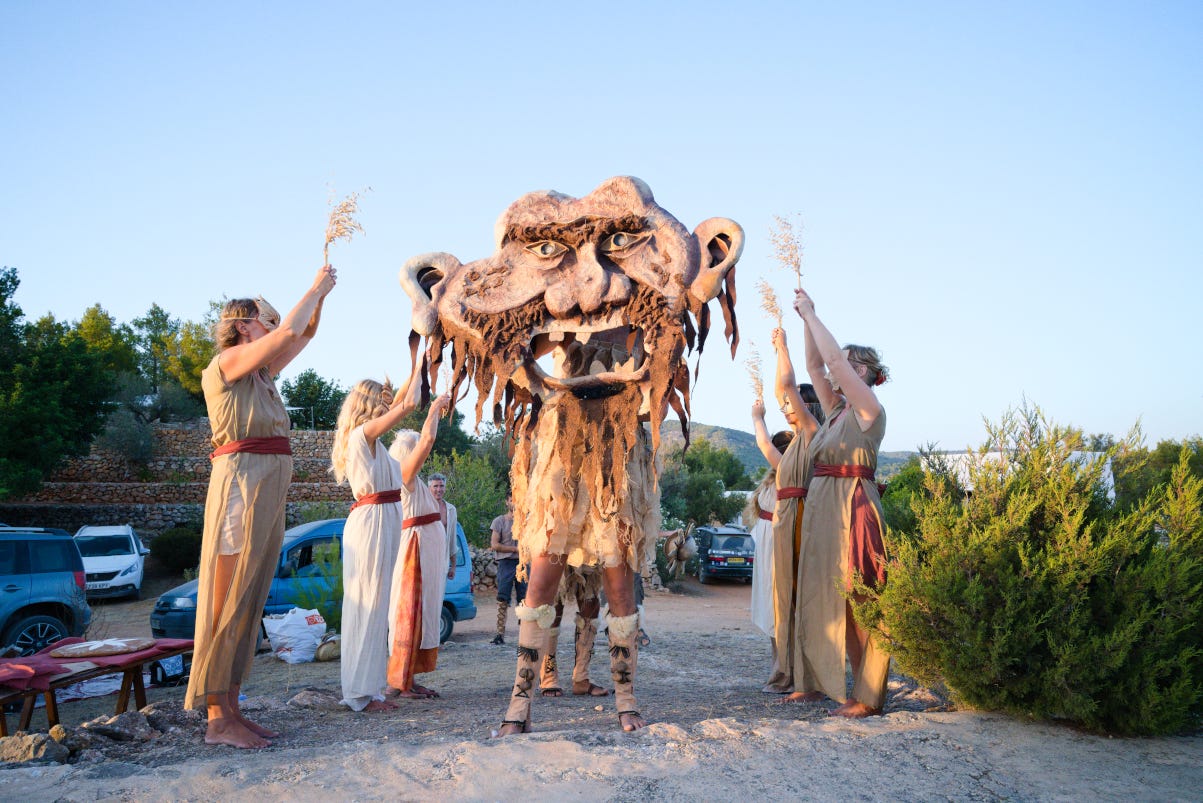
It’s that time of year again - once more, haystacks are starting to decorate the Ibizan fields, whilst local wheat farmers lament 60 days without rain. And as harvest season begins, I am remembering an ancient, cyclical story about wheat, bread and the sun which I began unearthing exactly two harvests ago, in early summer, 2021. It was a sprawling, epic story which led me into the bowels of local rural tradition and folklore, as well as sending me on a magical mystery tour along the ancient Mediterranean trade routes linking Ibiza with the homeland of its Phoenician settlers, in the Middle East. This story linking loaf, grain and solar deity explained to me, at last, the real meaning of sun worship on Ibiza… these findings manifested as a Wells of Tanit podcast episode, but truly found their form in the ridiculous, fairly illegal (due to the Coronavirus restrictions in place at the time) ritual theatre spectacle that was Festival of the Sun - a three hour partipatory performance event which took place on one of the largest threshing circles of Ibiza, in the remote Northwest of the island, to a total of approximately 90 audience members.
It is only now, two years later, that I am beginning to fully comprehend the cyclical nature of this story - how the annual threshing of wheat represents an unending flux of death and rebirth and, in turn, how a one-off, never-to-be-repeated ritual performance on a threshing floor can go on to have many more lives.
Aside from being witnessed by approximately 20 actors and artistic collaborators, and 90 audience members, Festival of the Sun was filmed by Enrique Villalonga of Filmótica, who went on to create a 20 minute short film, and visual/sonic exploration, of what took place. And maybe it sometimes takes two harvest seasons to realise that such a document, and the story behind it, are very precious things indeed… so those of you who are on Ibiza might be interested to know that on the evening of Friday 26th May, Festival of the Sun will be screened to the general public for the first time, at Filmótica Studio in Ibiza town, and I will be there to discuss the creation process and themes behind it. Full details are here. And meanwhile, this July, I will be transporting this story from Ibizan soil to the UK, in a talk provisionally titled 'Initiating Dialogues with the Landscapes of Ibiza through Ritual Performance' which I will be giving at the Land Skills Fair (more on that soon).
For now, I leave you with one more manifestation of this tale of loaf, seed, circle and sun - the full, unabridged version of a piece I wrote last year for White Ibiza - the Gourmet Edition. Images are taken from our 2021 threshing floor harvest ceremony.
Circle of Life
A piece commissioned by White Ibiza in 2022.
The story beneath Ibiza’s original artisanal bread is one which takes us on a journey right into the heart of Ibiza’s ancient culture, rural traditions and folklore. It’s a tale that weaves us into the fabric of island life in the days before tourism, when the Ibicenco people led a frugal but fulfilling existence centred around their relationship with the land, the local community, the shifting seasons and the cosmos. But you will also find that the story of Ibiza’s bread leads us along the ancient trade routes of the Eastern Mediterranean, to Phoenician lands, the birthplace of Ibiza’s first settlers.
To begin our story of the Ibizan loaf, we must start on home turf. Up until less than a century ago, Ibiza’s white-washed casas payesas, or country houses, represented virtually self-sufficient homesteads, providing all that a family needed for their basic subsistence. A plot of wheat, for baking the household’s bread, would have been an essential staple crop, and islanders were blessed with a particularly nutritious and delectable native seed variety called blat xeixa. Such was the reputation of this local Balearic grain that its high status is alluded to in a piece of prose written by the Mallorcan poet and musician Guillem d'Efak, set in the mid-15th Century: ‘…the rich eat xeixa bread, say the women as they weep / the rich eat xeixa but for the rest of us there is only mezcladizo’ (an inferior variety).
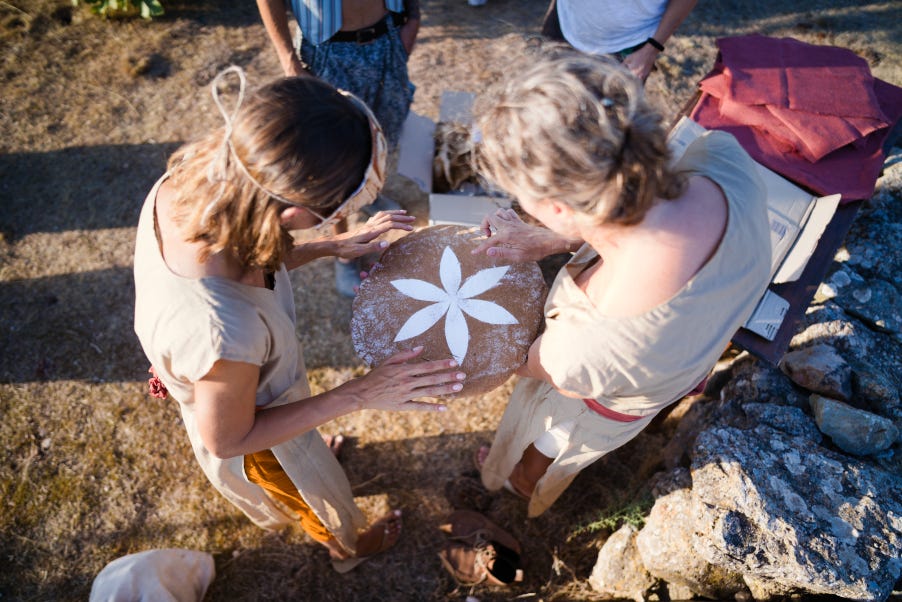
Once a plot of wheat grain had been sown, it was time for the almighty Balearic sun to take centre stage, ripening the golden sheaves until they were ready for harvesting. If the phrase ‘sun worship’ brings to mind bikinis and bronzing fluid, you might be interested to know that long before the advent of tourism, a very different sort of solar veneration took place on Ibiza. Local folklore suggests that the sun, regarded as an elemental force responsible for nourishing and fattening the all-important wheat crop, was honoured as an omnipotent, benevolent deity. One of the symbols most commonly displayed on traditional Ibizan furniture, and occasionally found above the doorways of Ibiza’s oldest houses to invoke protection, is the six-petalled rosette, universally recognised as a solar symbol. To this day, the shape is also marked onto traditional Irish Maslin loaves, which suggests that the same sun responsible for fattening golden ears of wheat was also revered as an almighty, life-sustaining force of goodness.
Harvest time would come in the early summer months – no doubt an arduous and sweat-inducing annual task for Ibiza’s rural folk. After these huge collective labours, Ibiza’s local folk-dance tradition, the ball pages, would typically take place beside the island’s wells. A highly-ritualised event which has evolved over the course of many centuries, it comes as little surprise that this folk dance, whose purpose was to offer thanks and gratitude to Ibiza’s precious freshwater sources, commonly coincided with the end of harvest time. At no other point in the year would the fundamental role of water be clearer to a population that simultaneously relied on the sun to fatten its crops, and withered from its relentlessly scorching rays.
In July and August came the task of threshing, the rural process by which locals would extract precious wheat kernels from their freshly-harvested crop. Although this ancient and culturally-significant practice has since been replaced by modern, mechanized methods, traces of it can still be found dotting Ibiza’s landscapes today, in the form of flat, circular threshing floors. In the Middle East, homeland of Ibiza’s first Phoenician founders, these solar-shaped arenas held great religious and spiritual significance. In Biblical terms, the agricultural process which took place on these threshing floors went beyond the simple labour of ‘separating the wheat from the chaff’ - it was seen as a sacred transformative act, symbolising the transcendence of the human spirit over the flesh.
Onto these raised platforms, Ibiza’s rural peasants would pile the year’s wheat crop, letting it first be toasted crisp beneath the fierce rays of the sun, then trampled upon repeatedly by a tethered animal, whose heavy hooves would crush the wheat, releasing treasured seeds from their fibrous husks. Later in the day, as the midsummer heat subdued and a soft evening sea breeze crept its way inland, the country people would fling forkfuls of the hoof-trodden wheat up into the air, further separating it from the heavier kernels contained within. By the end of the day, backs would be sore, filled sacks of grain would be wagon-loaded, awaiting transportation to the mill, and the accomplished task would no doubt be celebrated with wine, dance and song, into the cool depths of the night.
In Egyptian Arabic the word for bread, aysh, derives from the root 'yš, which means ‘to live.’ And the intrinsic connection between bread and daily, domestic existence can easily be observed in Ibiza’s traditional rural houses, which were almost always built to feature the swollen, white-washed curves of a bread oven, protruding gloriously from one side. If there is a mystery contained within those centuries-old ‘fincas’ which still sit nestled within Ibiza’s pine-forested folds, it must surely have something to do with those snow-white concave chambers adjoining them, within which an alchemy of fermentation and flames would have transformed, many countless times, a humble wheat flour dough into a dense, crusty loaf.
Ibiza’s traditional peasant bread might have been elaborated in the home, but it travelled surprisingly far. A food product readily available in most bakeries and groceries is the chunks of twice-baked, dried bread known as crostes, which can be soaked in water, then combined with chopped tomato, garlic and olive oil to create one of the island’s most typical and well-loved salads, of the same name. If crostes are a popular feature of Ibiza’s gastronomy that has endured to the present day, it is testament to the fishermen of days gone by. These seafarers discovered, through the ages, that dehydrated bread provided a conveniently durable food to take to sea on long voyages - the addition of some dried fish, olive oil and a little salt transforming it into quick and satisfying fare.
But it wasn’t just Ibiza’s fishermen who relied on homemade bread to fuel their exploits: traditional local folktales are filled with accounts of daring adventures and quests, the fierce-spirited protagonist invariably sustained by a small knapsack containing the definitive ibicenco picnic - a piece of sobrasada, (local cured paprika sausage), a couple of dried figs, a goatskin of wine, perhaps… but always, without question, a hefty, crudely-cut wedge of peasant bread.
This story of Ibiza’s bread is one which started with a seed, and ended with a loaf, but in its essence, it is a story of circles. We have followed the wheat crop through the seasonal wheel of the year, to the sun-scorched shape of the circular threshing floor, and to the curved dome of the traditional domestic bread oven. But though so many aspects of Ibiza’s cyclical rural ways have been lost with the passing of time, there might just be a final chapter of the story of Ibiza’s bread waiting to be written. As the island welcomes an influx of visitors with increasingly flexible economic means, and strong interests in health and nutrition, local produce and seed sovereignty, the xeixa grain once deemed too unproductive to grow and produce on Ibiza is now headlining a major new revival. With Ibizan farmers, bakers, chefs, restaurant-lovers and foodies now embracing the Balearic Islands’ most ancient wheat seed, we can confidently say that that the story of Ibiza’s bread is one not only rooted in the past, but firmly planted in the present.
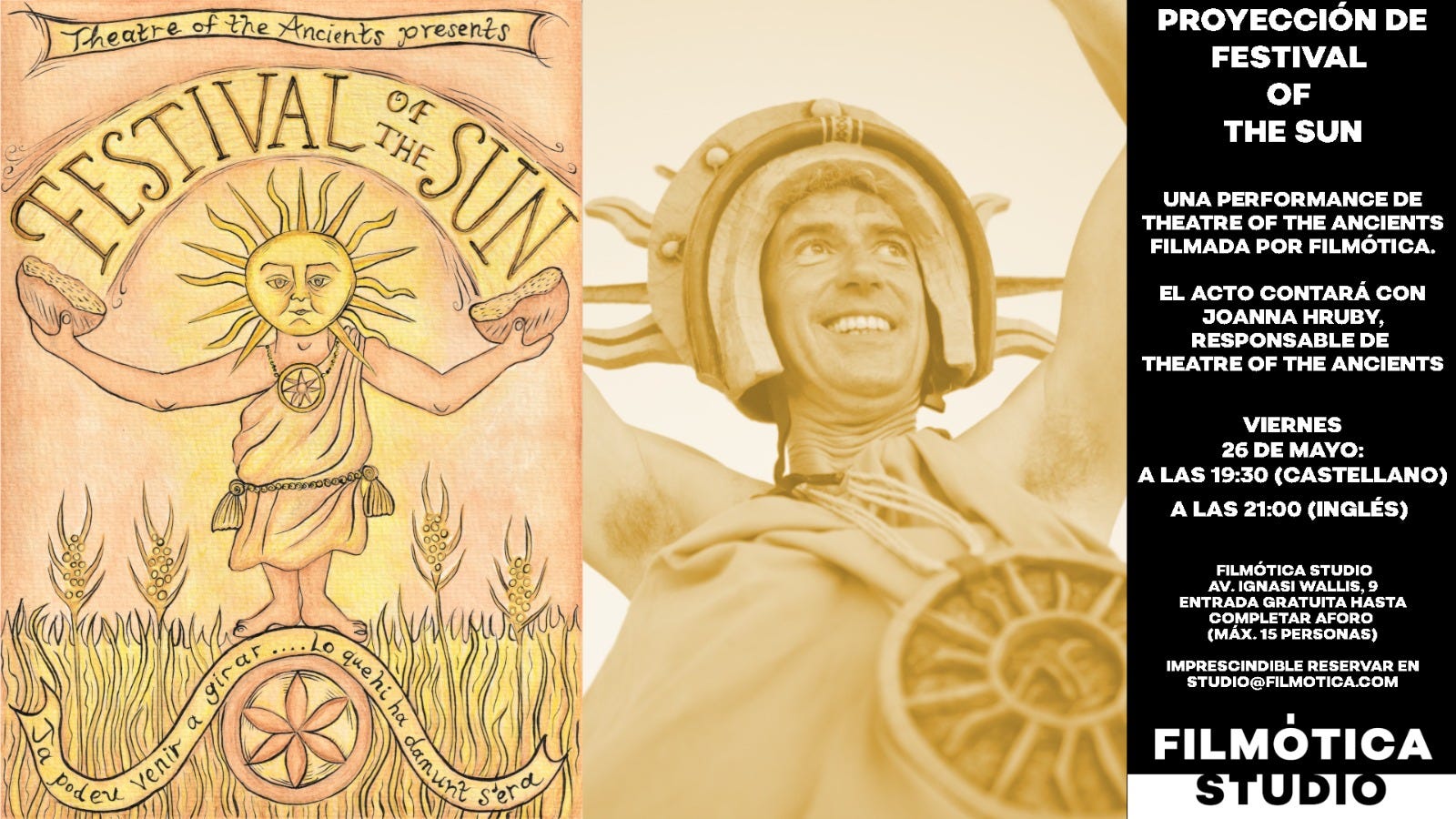
Festival of the Sun: short film screening on 26th May in Ibiza town, full details here.
< < Images:
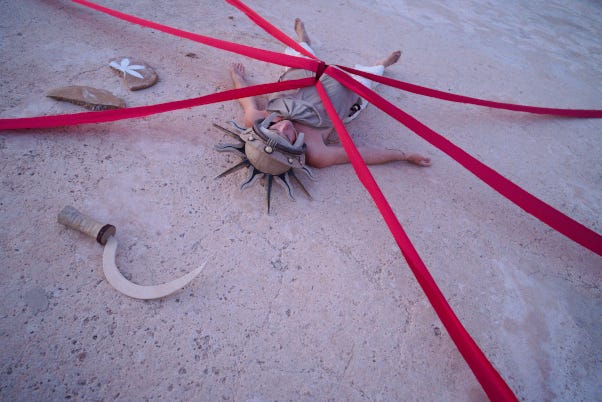
Official event poster for Festival of the Sun, performed in August 2021 (illustration by Joanna Hruby); photos from the dress rehearsal of Festival of the Sun, taken by Enrique Villalonga of Filmótica.